SARAH FANTINI
Trash Poetry: Avant-Garde Aesthetics
and Ecopoetics
Introduction
In 1909, Italian Futurist Filippo Tommaso Marinetti inaugurated a version of modernist avant-garde poetry that combined unconventional syntax with a technophilic and toxic aesthetic. His first manifesto, “The Founding and Manifesto of Futurism,” opens with a story in which he rolls his car over in a ditch and gulps down the “bracing slime” of a “fair factory drain” like breast milk, then emerges filled with joy.[1] Exhibiting a similar technophilic antinaturalism, or an anti-romantic reversal, Wyndham Lewis’s “Vorticist manifesto” of 1914 curses the climate of England, its “flabby sky” and “lazy air,” but blesses English ships, ports, machines, and the hairdresser, who “attacks Mother Nature for a small fee,” and lauds the modern world for its improvements on nature, having “reared up steel trees where the green ones were lacking.”[2] Joshua Schuster has named the technophilic antinaturalism of Marinetti and Lewis an aesthetic of “toxic refreshment,” and uses this as evidence to support his claim that “Modernism was never very green.”[3] And yet it is curious that many of the same literary techniques that were introduced with this ecocidal rhetoric have persisted into twenty-first century ecopoetics, where, supported by work within ecocritical literary studies, they are seen to promote environmentalist interests.
Evelyn Reilly’s Styrofoam (2009) is a case in point. The central interest of Reilly’s book is plastic: the man-made substance that is commercially mass-produced, an essential ingredient in modern conveniences and inventions, that is quickly discarded, but does not degrade within a timespan knowable to human meaning, that leaches toxic chemicals into lands and waters, that kills and is found in the bodies of birds and marine life.[4] But the book also considers the relationship between plastic and the human arts, which are also man-made out of manipulable materials. The central implications are that plastic and the plastic arts have the ability to influence, mould, and shape the world—materially and meaningfully—for better or for worse. Styrofoam shows its indebtedness to modernism in its formal features—such as collage structure, typographic variation, irregular uses of grammar and punctuation—while directly and indirectly alluding to modernist writers, including Gertrude Stein, D. H. Lawrence, Ezra Pound, and T. S. Eliot. At the same time, the work’s central concern with plastic joins an aesthetic of toxicity—of waste, of trash—to identify and problematise the continuity between human activities that destroy and create. And in this way, Styrofoam shares with Marinetti an alignment between a toxic aesthetic and linguistic unconventionality, albeit directed toward very different purposes.
Reilly’s Styrofoam is joined by a number of other twenty-first century poetic works with a central focus on plastic, including Adam Dickinson’s The Polymers (2013) and Orchid Tierney’s ocean plastic (2019).[5] However, my focus here is not specifically on a plastic thematic or on observing a generalisable trend within contemporary ecopoetics, but on the ways Styrofoam’s specific combination of a trash aesthetic and avant-garde formal features reveals literary critical interests in connecting twenty-first century environmental concerns with early-twentieth century modernism. This ties in with recent developments in modernist ecocriticism, which represented an unusual combination of scholarly interests in 2014, when Anne Raine’s pioneering chapter on “Ecocriticism and Modernism” was published in the Oxford Handbook of Ecocriticism, but had seen an explosion of academic publications by 2021, when Modernist Cultures dedicated a special issue to “Modernism and the Environment.”[6] A similar shift has occurred in ecocritical studies of contemporary poetry, which in the late decades of the twentieth century were structured by an opposition between directly representational ecopoetry and Language poetry, the dominant poetic avant-garde of the moment.[7] Lynn Keller has observed that this divide between Language poetry and lyric poetry, within both ecocriticism and the poetry scene, began to be bridged with the launch of Jonathan Skinner’s journal ecopoetics in 2001.[8] In the case both of modernist scholarship and of the study and practice of contemporary poetry there has been a slow process of alignment between ecological concerns and aesthetic practices with a modernist lineage.
These scholarly and creative trajectories signal the conventional association between modernist formal features and an antinature attitude, and critical attempts to dissociate them. In the introduction to his 2015 book Green Modernism, Jeffrey Mathes McCarthy stated that “to claim that nature is significant to modernism is to cut against the grain of a century of scholarship.”[9] In 2017, Matthew Griffiths made the case that formal and thematic features of modernist writing are “distinctively valuable to the comprehension of climate change,” including “language’s vexed attempt to engage with the world and, reflexively, with its own materialism.”[10] By the twenty-first century, it has become possible to argue that modernist poetic features support an environmentalist creative and critical project, even when those same features were introduced with an explicitly antinatural rhetoric.
There are multiple possible ways to parse this incongruity. One would be to consider how the features of the poetic avant-garde inaugurated by Marinetti became separated from his initial project. This happened first with Russian Futurism’s and Dada’s reformulations of Futurist aesthetics, which initiated a series of similar transformations made by avant-gardes throughout the twentieth century. From the 1970s, the Language poets were particularly influential in reformulating modernism to address Cold War era concerns—a topic I will discuss further in the course of this article with reference to the work of Natalia Cecire. Another path would consider the philosophical currents enabling reformulations of modernism, starting from the French poststructuralism that informed postmodernism and the Language poets, and its extensions into twenty-first century branches of eco-theory, including new materialism and posthumanism, which inform the work of many ecopoets and ecocritics.[11] A further path might consider the way ecological concerns present an additional motivation for revisions of the modernist canon that began in late twentieth-century scholarship, initially motivated by gender and race politics.[12] However, my goal in this article is not to explain how or why ecological concerns in poetry and criticism became aligned with modernist aesthetic practices. These considerations stand as background informing and situating my analysis, though I do not seek to resolve them here. Rather, this article seeks to observe, through close reading, actual points of affinity between Italian Futurism and twenty-first century ecopoetics, including resistance to the pastoral and investment in the transformative power of such aesthetic disruptions.[13] Closely analysing those affinities demonstrates how, over a century apart, similar formal practices are put to vastly different uses. What remains consistent is that they are ostensibly put to use. The trash aesthetic serves to reveal both these points of alignment and discordance.
I have adopted the term “trash,” here, rather than a roughly synonymous term, for its association with both household refuse and unvalued cultural material; more frequently used in American colloquial English, the term matches this article’s particular focus on the connections American contemporary poets have made between literary material and urban pollution. However, there are moments where “waste” is a more appropriate term, and it takes on a further set of connotations that are at times more regenerative than “trash.” Around 2012–2015, there were a number of publications on “waste poetics,” including Christopher Schmidt’s The Poetics of Waste: Queer Excess in Stein, Ashbery, Schuyler, and Goldsmith (2014), which argues that “waste, in its various literal and metaphorical manifestations—detritus, garbage, trash, shit—is a crucial influence on twentieth-and twenty-first-century aesthetics, not only in the visual arts, as has been previously recognized, but in the poetic arts as well.”[14] In this article, I explicitly connect that influence to Futurism. Schmidt prefers the term “waste” for its abstract, euphemistic, “and even bureaucratic” qualities; his study joins a larger discourse on waste within ecocriticism and the environmental humanities, but focuses on the role of waste in market relations and queer subject formation.[15] These interests combine in the work of two further contemporary American poets I turn to in the latter part of this article—Harryette Mullen and CAConrad—who, like Reilly, combine a trash aesthetic with avant-garde techniques. By closely reading examples of their work, I show how this combination operates to serve an explicitly emancipatory politics, which is at times ecopolitical, but also anti-racist, anti-war, and directed toward feminist and queer empowerment. With these readings, I demonstrate that contemporary ecopoetics shares formal and thematic features with Italian Futurism, while also sincerely directing these features toward antithetical purposes. The principal features which ecopoetics takes from Marinetti are the troubling of the lyric subject and representation, attention to the materiality of language, and a focus on the text’s relation to its exteriority. These were introduced with a revolutionary rhetoric and have continued to be seen as transformative poetic strategies in the twenty-first century.
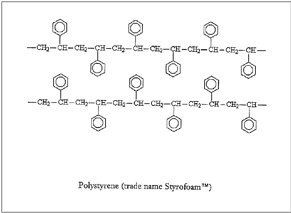
Figure 1. Excerpt from the opening
page of Styrofoam featuring a diagram
of a polymeric chain for polystyrene. Reprinted with permission
from the publisher, Roof Books.
Styrofoam—Plastic Language
Reilly’s Styrofoam contains nine long poems, comprising assorted media such as textual fragments, both original and borrowed, images, diagrams, and charts. In addition to the mixed-media composition, the sequences of poetry show indications of their own collagistic layering, with variations in spacing, punctuation, capitalization, style, and register, such as rapid shifts from scientific language to literary allusions, to brand names, movie references, blog posts, and web addresses. In an example of the scientific register, the book opens with a diagram depicting the polymeric chain for polystyrene (Fig. 1). And on the page opposite, toward the beginning of the first poem, titled “Hence Mystical Cosmetic Sunset over Landfill,” we are given plastic ingredient lists:
[hat: 59% Acrylic 41% Modacrylic]
[ornamental trim: 24% Polyvinyl 76% Polyamide]
holding a vial
enwrapped
Enter: 8,9,13,14,17-ethynyl-13-methyl-
7,8,9,11,12,14,15,16-octahydro-cyclopenta-diol[.][16]
Here, the flow of poetic text is interrupted by the visual, the numerical, and the informational. The use of specialist terminology, figures, and diagrams resembles the experience of reading a scientific paper, but the fragmentary presentation of scientific discourse within a poetic text functions to disorient and alienate, rather than inform. Further along in this poem, the discomfort takes a different turn, where what seems to be a product review or blog comment is pasted into the poem:
Monica T
Soft and satisfying for infant teething if you first freeze.
posted 10/11/2007 at thriftyfun.com
hosted by FPPG the Foodservice Plastic Packaging Group
All this.formation
anddeformation
& barely able to see sea[.][17]
The same page also features an allusion to Samuel Taylor Coleridge’s The Rime of the Ancient Mariner (1798):
(for all averred, we had killed the bird [enter albatross
stand-in of choice[.]
And at the end of the page appears a list of light density measurements:
sunset 400 lux
LCD computer screen 300 lux
full moon .25 lux
starlight .0005 lux[.]
I provide this group of examples here as an initial demonstration of the variations in register that appear in Styrofoam. Rather than elaborating each excerpt through close-reading, I present them to show the relations they establish between different visual and textual modes. For one, the variations in register create a movement in the work, between expansion and compression, or tension and release. The lyrical moments, like “holding a vial / enwrapped,” are openly spaced on the page and thus seem to breathe, while the lists, websites, and compressed spaceless combinations of words (such as “All this.formation / anddeformation”) produce discomfort, tension, contraction. This tension is compounded by the use of what appear to be throwaway pieces of language—blog posts, brand names—which become intermingled with decontextualised and detached literary fragments. The poetry becomes cluttered with aesthetically displeasing forms of writing, which might be considered instances of cultural trash. Like a heap of rubbish, the assortments and juxtapositions of disparate materials contribute to the experience of repulsion: when collected together with other discarded and devalued materials, even those items once treasured become abject.
With its use of found text, variations in genre, medium, and register, and inconsistent use of typography, spacing, and punctuation, Styrofoam shows an allegiance to the collage form. As a formal choice, collage carries polemic implications. Marjorie Perloff has observed it was “perhaps the central artistic invention of the avant guerre,” or pre-World War 1 avant-garde.[18] Drawing from Renato Poggioli, Perloff has named this, “the Futurist moment”: a revolutionary moment which aligned an “avant-garde aesthetic, radical politics, and popular culture,” but which was short-lived, and quickly “gave way to the anarchic and nihilistic spirit of Dada,” and then to the longing for transcendence which gave impetus to the Surrealist movement, but also “the proto-Fascist strain that was to make late European and American Modernism so problematic.”[19] For Perloff, collage takes on the revolutionary spirit of the Futurist moment due to its “situational aesthetic,” which focuses attention on relation and exteriority: collage “incorporates directly into the work an actual fragment of the referent, thus forcing the reader or viewer to consider the interplay between preexisting message or material and the new artistic composition that results from the graft.”[20] These capacities of collage become especially significant in ecopoetics, which is principally concerned with the relations between the text and an exterior, extratextual world.
Twenty-first-century ecopoetics picks up on the political implications of collage’s resistance to coherence. For example, Styrofoam draws together items from disparate points of origin—from arctic oceans to urban homes, from classical literature to genetic science. This bringing-together of disparate items in uneasy arrangements models an “ecological” way of thinking, as it is understood in ecocritical discourse. Zach Horton describes ecology as “the study of biotic systems (which include abiotic elements as well),” including culture and technology; importantly, ecology makes “its focus the relations between a species and all of its ‘conditions of existence.’”[21] Ecology shifts the focus away from the coherence of the organism that underpins biology, but it also opens its object of study to include, potentially, everything. The collage—along with its “cognates,” as Perloff calls them, “montage, assemblage, construction”—functions to aesthetically render such a relational way of thinking.[22] When relation is the focus, it follows that attention shifts away from a particular referent, including a natural object or a lyric subject. Collage functions both to decentralise the creative authority of the poet and to destabilise representational practices. Collage has a deep presence within modernism, showing up with different stylistic attributes across works from a number of avant-garde movements, including Surrealism and Dada.[23] However, it was Futurism which first connected the collage aesthetic to a revolutionary spirit. Collage is used by twenty-first century poets towards ecopolitical ends, and both the aesthetic features of collage and the sense that the compositional method is political (even ecopolitical) owe something to Futurism.
One technique that contributes to a collage aesthetic in twenty-first century ecopoetics is a particular form of intertextuality, the “found text”. In 2009, acknowledging the inheritance of this practice from modernism, Harriet Tarlo observed that after a call for submissions for a special feature on ecopoetics for the journal How2, the majority of entries included “found text,” indicating that textual “recycling,” as she called it, is a dominant ecopoetic technique.[24] Tarlo’s account suggests that the collage is a form that dramatizes collective composition and embeddedness within an exterior world; at the same time, repurposing linguistic material is to be understood metaphorically as a practice of repurposing waste, thereby aligning a specific literary technique with environmentally-minded behaviours.[25] The idea of text-as-waste was a central theme of Jed Rasula’s This Compost (2002), an anthology of poetry and essays premised on the idea that “all our literatures are leavings” and a work that stands as a significant foundation text for twenty-first-century American ecopoetics.[26] But the metaphor of literature-as-compost ascribes positive associations to cultural waste, as something fertile and regenerative in its process of degradation. Considering literature as recyclable, rather than compostable, aligns it with the inorganic, the non-biodegradable, and the plastic—which is an alignment also made within Reilly’s Styrofoam.
The theme of literature-as-plastic is present from the epigraph that opens Styrofoam, an excerpt from Kit Robinson’s poem, “In the American Tree” (1978).[27] Robinson’s poem also opened, and provided the title for, In the American Tree, Ron Silliman’s 1986 anthology of Language writing, a movement that was localised around the San Francisco Bay Area (joined by contributors from the East Coast) and which Perloff has described as “the most prominent American poetic avant-garde of the ’80s, and ’90s.”[28] Reilly’s choice of Robinson’s poem for the epigraph, alongside her stylistic choices, reinforces her work’s connection to the lineage of the Language poets. The final five lines of Robinson’s poem form Reilly’s epigraph, which reads:
The goddess herself
is really
Feeling great.
Space assumes the form of a bubble
whose limits are entirely plastic.[29]
Joined with another image that appears earlier in Robinson’s poem, of “a dream- / like medium you find it impossible to pierce,” this “bubble,” envisaged with plastic limits, seems to be an experience of language as the medium through which one can experience the “field,” “tall green trees,” features of a material environment that are “not quite within grasp.” Robinson’s poem suggests a mediated experience of the referent, and an awareness of that mediation, while also recognizing the “plastic” limits of the medium. As the opening and title for the Language anthology, “In the American Tree” joins Silliman’s preface in positioning Language poetry against a “natural,” speech-like style of poetry described as dominant in the 1970s.[30] Reproduced in Reilly’s epigraph, the focus of the final lines shifts from examining the function of language to examining the impacts of language on the natural referent, implying that if the limits of language are plastic, then stretching those limits can shift the parameters of relation with the natural world.
Reilly’s work continues to play on the multivalence of the term “plastic”: both a substance and a property of substances; both a pervasive feature of a human-impacted physical environment and the mediated encounter with it. This multivalence is made explicit in the sequence titled “A Key to the Families of Thermoplastics”:
and the DuPont™ StormRoom™
WithKevlar®️
Proven by Science to be virtually impenetrable
as a barrier for protecting families from harm
PEMD and PEHD, also known as ultra high
molecular weight polyethylene THE QUEEN
OF VENEERS AND SURFACING MATERIALS
and LCP, a liquid crystal used in walls as thin as 0.2 mm
electrical components, machine parts, surgical devices
FOR “INFINITE PLASTICITY IS THE ESSENCE
OF THE SPIRIT” (HEGEL CORNUCOPIA)
as in PET, which begins with a film of molten polymer
extruded onto A CHILL ROLL
dairy product lidding, comic book bagging, and
ARCHIVAL QUALITY DOCUMENT STORAGE
USED BY THE LIBRARY OF CONGRESS[.][31]
The content of this sample is largely informational, listing a number of types of plastic and their uses. However, this informational register is also interspersed with an advertiser’s voice, trademarked brand names, cinematic and philosophical statements. At other moments within the sequence, the pop-cultural and intimate registers come to the fore, with further references to horror movies such as Alien (1979) and The Blob (1958) and a disconnected familial address: “(HI MOM).”[32] The quotes from philosophers (G. W. F. Hegel, Slavoj Žižek) are here labelled “cornucopias”—symbols of mythical abundance that can provide whatever is desired—gesturing back to a photograph that appears at the opening of the sequence, captioned “King holding a cornucopia, symbol of abundance and ‘inexhaustible store.’ Stone relief, 2nd–3rd century AD [from] Iran.”[33] In this context, the word “plasticity” in the quote from Hegel becomes double-edged, suggesting the adaptability and malleability of the human spirit, and also the human ability to shape the world in accordance with this self-conception—like the production of an abundance of plastic which transforms environments.
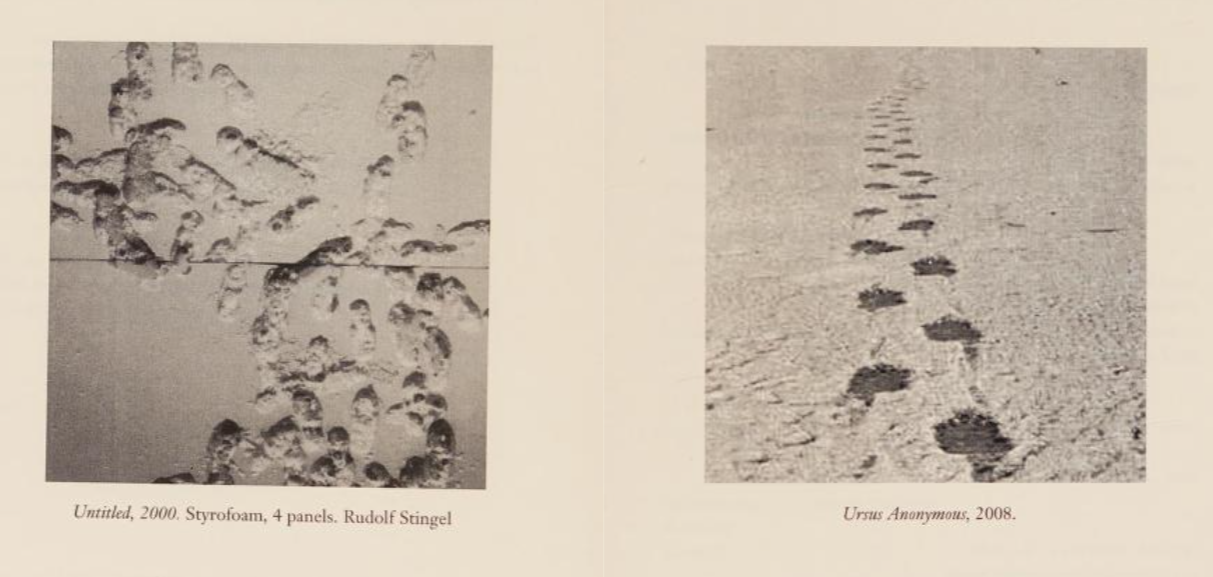
Figure 2. Reproduction of facing
pages from Reilly’s Styrofoam, containing
a photograph of Rudolph Stingel’s Untitled (2000) and a
photograph found
on the internet of bear paw prints in snow. Reprinted with
permission
from the publisher, Roof Books.
“Plasticity,” then, characterises the human spirit and the limits of language. Plastic enables new invention but also remains a potentially destructive substance. Lynn Keller reads an ambivalence in Reilly’s work toward human invention and qualities of the aesthetic, recounting Reilly’s claim in a private interview that it was Styrofoam art which prompted the book’s project.[34] One of these works appears on page 18 of Styrofoam, a photograph of Rudolf Stingel’s artwork, Untitled (2000). The original work was “made from four thick Styrofoam panels on which Stingel apparently walked in boots dipped in lacquer thinner, which melts Styrofoam” (Fig. 2).[35] The resulting pieces look like footprints left in snow.
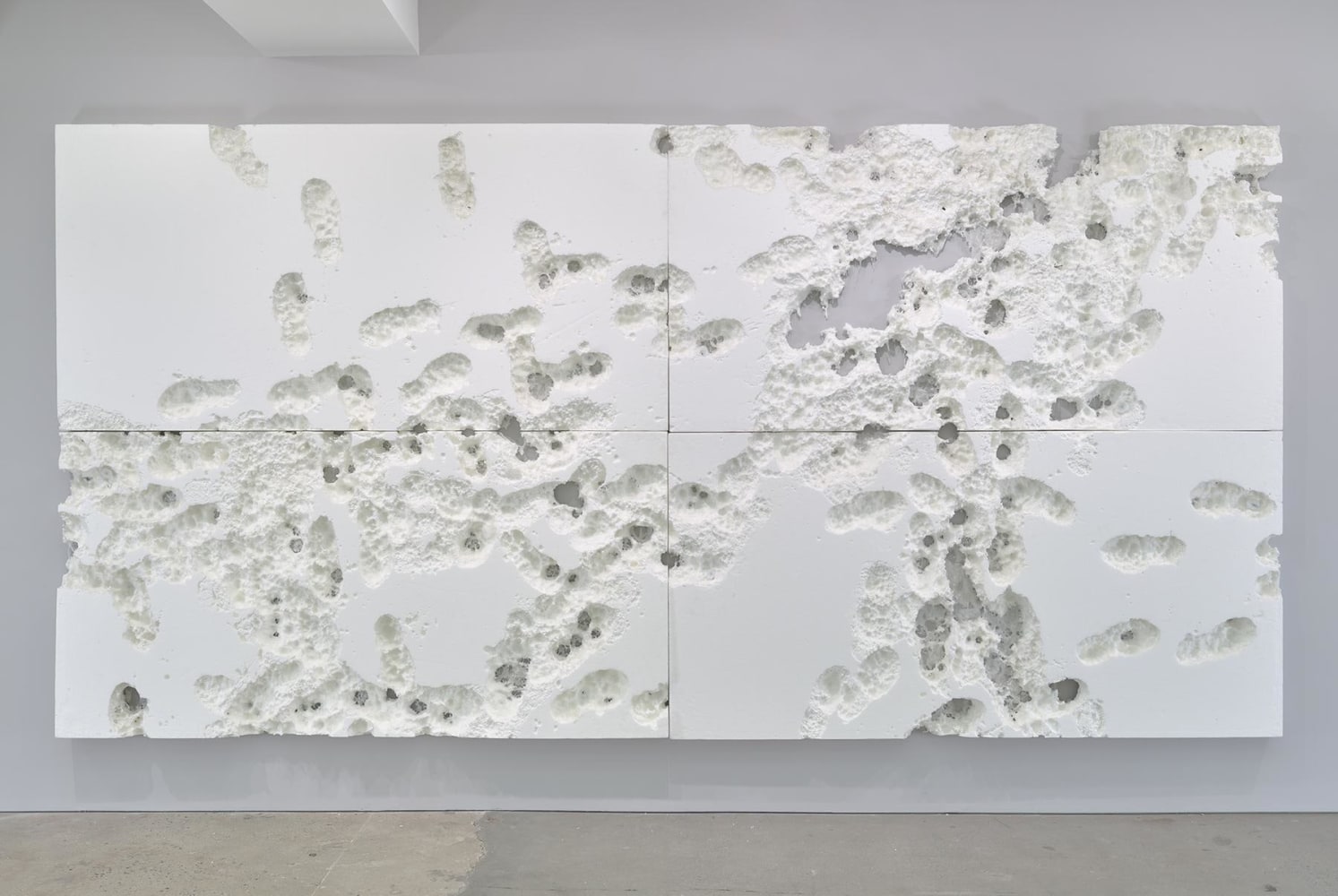
Figure 3. Gallery photograph of
Rudolf Stingel, Untitled (2000). Styrofoam,
4 panels. Photograph by Tom Powel Imaging from 2015–2016
exhibition
at Nahmad Contemporary, New York. Reprinted with permission
from the artist.[36]
Keller draws from an interview with Reilly to observe of these works that, “Striking [Reilly] as ‘incredibly beautiful and joyous,’ their combination of ‘problematic materials’ and ‘beauty’ caught her imagination.”[37] Reilly places opposite the photograph of Stingel’s artwork what Keller describes as “a grainy photo taken from the Internet of a line of bear paw prints on a crust of snow, which she has playfully titled Ursus Anonymous, 2008” (ursus meaning “bear”).[38] Such juxtaposition invites the reader to contemplate the similarities and differences between the two images, both aesthetically and ecologically. Amongst all the species whose survival is imperilled due to anthropogenic climate change, the polar bear stands out as a significant symbolic victim, perhaps for its icy habitat’s proximity to the sublime. However, within Reilly’s work, in the reproduction of these two particular images—of Stingel’s art and of bear paw prints—in black and white low resolution, the effect is not exactly sublime. The reproduction flattens the images into something a little more kitsch. These images can be compared against the gallery images of Stingel’s Styrofoam art, which have a scale and spatial arrangement that produces an effect of grandeur and invites the aesthetic ambivalence which Reilly felt (Fig. 3). Such a flattening within the text speaks to Reilly’s remark that “I think that ecopoetics must be a matter of finding formal strategies that effect a larger paradigm shift and that actually participate in the task of abolishing the aesthetic use of nature as mirror for human narcissism.”[39] This suggests that a sublime aesthetic carries a capacity for harm and that there is something to be gained by devaluing existing categories of aesthetic value.
Poetic experimentalism thus presents itself as an aesthetic strategy that resists reinforcing social values tied into judgments of beauty. For Keller, Reilly’s ambivalence seems to resolve into a tentative hopefulness, where “The intriguing characteristics of plastic,” in “enabling new formations,” “may open possibilities for ways of thinking alternative to those that brought us to our present environmental crises.”[40] Ecocritics Mandy Bloomfield and David Farrier have made similar arguments, connecting Reilly’s use of linguistically innovative techniques to a world-changing potential. For Bloomfield, “Ecopoetic interventions into the vocabularies through which we articulate ecological relations have the potential to model more ethical forms of knowledge, perception and natural-cultural entanglement.”[41] For Farrier, “Reilly’s polymerized chains of association allow readers to appreciate the dense entanglement of entities that appear at first to be bounded by a reducing logic of scalability.”[42] For these three scholars, new linguistic constructions enable new modes of thinking that can potentially feed into a different kind of reality—another plasticity, but this time for the better.
The language used by these critics, of “entanglement,” “new ways of thinking,” and the attachment of ethical and political consequences to such ontological approaches, demonstrates their indebtedness to thinkers such as Bruno Latour, Karen Barad, Donna Haraway, and Jane Bennett, who inform a category of new materialist or posthumanist ecological theory. For example, Latour made the case that a widespread change in Western ontology will have significant material effects in the world; he argued for replacing the ontological separation of nature from culture with a concept of “ecology” that stresses the interrelation between the two. And much of the work to be done is conceptual and linguistic. In his Facing Gaia lectures of 2017, Latour claimed that, “To sum it up rather too quickly[,] for Westerners and those who have imitated them, ‘nature’ has made the world uninhabitable.”[43] That is, “nature” as a category separable from “culture.” Ontology, for Latour, is both the cause of the problem and the means of a solution. In We Have Never Been Modern (1993), he argued that when we become aware of our practices of conceptual separation, we cease to be modern, to have ever been modern, and “our future begins to change.”[44] Barad has reinforced the claims for the efficacy of ontology by scaling up theories from quantum physics to demonstrate that practices of observation are inextricable from what is observed; here, “entanglement” becomes an important alternative to ontological bifurcations, such as that between subject and object, and this concept has been influential for a large field of feminist and queer eco-theory.[45] However, many would dispute such a belief in the power of ontology to change the course of history, including Marxists such as Fredric Jameson, who posited in A Singular Modernity (2002) that ontological bifurcation, and in particular the dominant relationship and subsequential violence of subject over object, is caused by capitalism, not the other way around.[46] For Jameson, a widespread shift in collective thought is the consequence, not the cause, of reconfigurations in material conditions.
While Jameson’s position might form one basis for a challenge to the ecocritical readings of Styrofoam, there are more. One concerns the extent to which poetry is an effective medium to facilitate a widespread ontological shift. A further challenge concerns the role of literary criticism in activating that medium. On a similar note, Timothy Clark has critiqued ecocriticism for extending the discourses of “libertarian humanism” into environmental concerns and has questioned whether new materialist ecocritical discourse is “committing a fallacy to which much academic life is prone: that of ascribing most problems and ills of the world to some sort of intellectual mistake or set of false assumptions, as if all human society were an academic seminar writ large.”[47] In order to get to the arguments made by Keller, Bloomfield, and Farrier, one must have faith in the power of ontology to change the world and must believe that experimentalism in poetry is the means by which to bring about a widespread ontological shift. In lieu of remarking on the plausibility of these assumptions, I propose that this belief is very similar to that which inaugurated the modernist avant-garde. When it comes to poetry that operates within an experimental or avant-garde lineage, ecocritical readings of such works are, implicitly or explicitly, drawing upon those principles about the agency of unconventional writing espoused by Marinetti, whose interests would seem to be at odds with those of ecopoetics in almost all respects.
From Futurism to Ecopoetics
Styrofoam exhibits multilayered debts to modernism. The volume includes direct references to a number of modernist writers, including Stein, Pound, and Lawrence, which are detailed explicitly in the notes.[48] But the poems also do more to invoke modernist works beyond these explicit references. The work of Stein further underlies the text’s attention to the materiality of language—the way that it looks and sounds and operates plastically and relationally as a thing amongst other things in the world. In addition, the combination of a waste aesthetic with abundant literary and cultural allusions owes a lot to Eliot’s The Waste Land (1922). Bloomfield connects Reilly’s work to Charles Olson’s late-modernist “open field poetics,” drawing upon Reilly’s own claims that Olson’s “abandonment of the idea of a center” provides a significant model for ecopoetics.[49] The use of specialized technical diction and the openly spaced arrangement of words on the page also recall the poetry of Mina Loy. And the engagement with a waste aesthetic resonates with the work of the Baroness Elsa von Freytag-Loringhoven, a more recently canonized modernist and New York Dadaist, who incorporated trash aesthetics into her poetry, performances, sculpture, readymades, and costumes.[50] Styrofoam is a case-text that demonstrates the way modernist formal features have been deployed in service of environmentalist commitments in twenty-first century ecopoetics. However, many recognisable modernist poetic features—such as unconventional syntax, the open spacing of words on the page, collage effects, and themes of waste or toxicity—were initially introduced by Marinetti. He also explicitly presented these features as political or agential strategies via a multitude of manifestos; his were the first to self-consciously repurpose that political genre for art.[51] In this section, I further analyse Italian Futurist manifestos to demonstrate that twenty-first century ecopoetics has retained from this movement a rejection of the pastoral, a problematisation of the lyric subject, and a commitment to the agency of unconventional writing.
I opened this article with quotes from Marinetti’s “The Founding and Manifesto of Futurism,” in which the image of the “bracing slime” of a “fair factory drain” initiates an aesthetic reversal from Romanticism, shifting the subject of poetic apostrophe from natural beauty to industrial waste. Such a reversal is technophilic and anti-pastoral, and it ties in with the larger aesthetic concerns of Futurism. From this first manifesto, Marinetti began to articulate his plans for poetry, claiming that “Up to now literature has exalted contemplative stillness, ecstasy, and sleep. We intend to exalt movement and aggression, feverish insomnia, the racer’s stride, the mortal leap, the slap and the punch.”[52] On the one hand, these ambitions are expressed in terms of aggression and tyranny: “Poetry must be conceived as a violent assault launched against unknown forces to reduce them to submission under man.” On the other hand, this poetry positions “matter” and machinery as the objects of adoration, in place of nature and woman; Marinetti calls for poets to affirm “the beauty of speed,” and to “increase the fervour of the primordial elements.” The poet, then, is not only given the role of celebrating the machine, but of bolstering the elemental forces that power it.
The founding manifesto was later followed by Marinetti’s “Technical Manifesto of Futurist Literature” (1912), in which he outlines his direct instructions for Futurist poetry. This manifesto proclaims the agential power of the destruction of syntax, proposing an end to “free verse” and its replacement with parole in libertà, “words in freedom.”[53] The manifesto contains a number of commands to writers, such as “It is imperative to destroy syntax and scatter one’s nouns at random, just as they are born,” “use verbs in the infinitive,” and abolish adjectives, adverbs, punctuation.[54] Significantly, Marinetti also demands that writers “Destroy the ‘I’ in literature: that is, all psychology,” and that they “Substitute, for human psychology now exhausted, the lyrical obsession with matter.”[55] The larger purpose of such an “obsession with matter” becomes more apparent in the concluding remarks of the manifesto, which read like a frenetic sci-fi mission to merge human flesh with the metal of motors and, in so doing, to “liberate man from the idea of death, and hence from death itself, the supreme definition of the logical mind.”[56] This manifesto for literature attempts to reach beyond the textual by attaching itself to a fantasy of human immortality through technology, which also amounts to a liberation from nature.
Marinetti’s desired relationship with matter is expressed with a provocative mix of intimate and violent rhetoric. The destruction of the “I” in literature, to be replaced with “the lyrical obsession with matter,” reads almost like a generous self-surrender, a non-anthropocentric reverence for matter. But Marinetti’s emphasis on “matter” breaks nature down to those forces that give life to machines. Marinetti declares, “We want literature to render the life of a motor,” and “Nothing […] is more interesting than the action of mechanical piano’s keyboard,” than “the dance of an object” on film, or than “a man driving [a car] at two hundred kilometres per hour.”[57] This technophilia is expressed as historical progress: “After the reign of the animal, behold the beginning of the reign of the machine.”[58] Elsewhere, this antinatural stance becomes violently hostile towards nature. In Marinetti’s “Let’s Murder the Moonlight!” (1909), Paoli Buzzi, appearing as a character within the narrative, sadistically revels in the Earth’s suffering: “Do you hear the sobs of Earth? … The Earth is suffering in the horror of light! […] Give me some clouds, some cloud-masses, to cover her eyes and her weeping mouth!”[59] The misogynistic violence underlying the rhetorical treatment of a feminised earth is also very much a part of this attitude of hostility toward nature. Nature and woman are here aligned as figures of the “past” to be rejected, both as subjects of representation and as models of a cultural ideal.[60]
But the characteristic contradictions across the multitude of Futurist manifestos leave some ambiguity as to whether the “nature” to be rejected includes actual nature or only its rendering in artistic representation. In his “Absolute Motion + Relative Motion = Dynamism” (1914), Umberto Boccioni declares: “It’s not the case that we are AGAINST NATURE, as the naive and retardataire advocates of realism and naturalism have charged, but that we are AGAINST ART, i.e., against the static conception which has been dominant for centuries.”[61] In fact, he claims, “We are closer to nature, and we will conceive of the world according to what is true, shifting ourselves into things rather than reproducing them in a descriptive sequence.”[62] Boccioni’s claim here is compatible with Marinetti’s desire to “suppress this intermediary” of syntax, “so that literature can directly enter the universe and become one body with it.”[63] Futurism may have been technophilic, but it appreciated some aspects of nature—those dynamic physical forces that enabled speed, velocity, propulsion—and the Futurists wanted to produce an art that harnessed the power of natural forces in the same way machinery could. Boccioni qualifies the Futurist position on nature: the problem is not nature as such, but the artistic tradition that elevates it as the static subject of representation.
Marinetti’s demands for the abolition of syntax, for irregularities in punctuation and typography, and for opposition to the lyric “I” and representation permeate much avant-garde poetry throughout the twentieth century but become removed from Marinetti’s initial purposes. One beginning of this separation can be seen with Dada, the predominant movement that succeeded Futurism, taking many of its formal characteristics while delivering them with antithetical rhetoric. When Dada emerged on the stage of the Cabaret Voltaire in Zurich in 1916, its genres of nonsense and noisy performance poetry drew inspiration from Marinetti’s onomatopoeic parole in libertà, which he had performed in a “terrifying volume of noise” at the Futurist serate.[64] Early on, Dadaists Tristan Tzara and Hugo Ball were explicit about the ways Italian Futurism had activated and inspired Dada, but they gradually distanced themselves from it as Dada became more established. Günter Berghaus has observed that the “Zurich artists took over many of the premises of Italian Futurism, but step by step drained them of their old meaning and filled them with a new purpose, thus moving beyond the parameters that defined Futurist art.”[65] By 1918, when Tzara published the “Dada Manifesto,” he saw Dada as having superseded Futurism and sought to sever connections with the earlier movement.[66] The differences between the two movements were political and aesthetic, which included differing stances on war, science, and technology.[67] However, their political positions solidified later, with Futurist politics hardening into a proto-Fascism in the 1920s, while it was Berlin Dada that, after the war, expressed a more coherent anti-war, anti-capitalist radical left politics.[68] The germs of these opposing political positions had been present in the rhetoric of each group from their earliest inceptions, but pre-war Futurism and the Dada of the Cabaret Voltaire had been anarchic, contradictory, and often nonsensical—organized primarily around the performance context.
This theatricality defines Futurism, according to Martin Puchner. More specifically, Futurism is defined by the theatricality delivered by Marinetti’s self-conscious appropriation of the genre of Karl Marx’s and Friedrich Engels’s Communist Manifesto (1848) to achieve aesthetic, rather than political, goals.[69] Puchner claims that, ultimately, the form of the manifesto is “the very content of futurism,” as “the artistic realization of this program through the making of artworks became a secondary concern.”[70] Perloff has also observed that, in comparison to its innovations in the manifesto, performance art, and typography, “Futurism’s literary contribution was weak.”[71] For Puchner, the art manifesto takes the theatricality of the manifesto “to an extreme”: “Where the political manifesto sought to subordinate theatricality to performativity, intending to turn the pose into the real thing, the art manifesto inverts this hierarchy, admitting frankly to a dominance of theatrics over authorized speech acts.”[72] Furthermore, Futurism’s theatricalization of the manifesto built on a broader “theatricalization of art,” which came to inform “all subsequent avant-garde movements, changing art beyond recognition.”[73] Puchner’s reading undermines the supposed “performativity” to which avant-garde art aspires, returning its attempts at agency to the more ephemeral horizon of theatrical performance. His argument is informed by the work of Janet Lyon, who argued that in London between 1909 and 1919, where the manifestos of Marinetti and Lewis were printed side-by-side with those of militant workers’ groups and of Suffragists in newspapers and on billboards, the impression of the aesthetic avant-garde as politically revolutionary was dependent on the “anti-bourgeois spectacle of suffragist violence.”[74] Lyon maintains that the manifesto requires this pairing with collective action in order to achieve political efficacy.[75]
However, the literary experimentalisms of the late twentieth century and of early twenty-first-century ecopoetics have maintained faith in the agency of avant-garde aesthetics. If early twentieth-century Italian Futurism and early twenty-first-century ecopoetics have very different political interests, their continuing resemblance in form and strategy can be explained by a shared reaction against pastoral poetry. The “post-pastoral” position is central to Jonathan Skinner’s essay on “Ecopoetics” in American Literature in Transition, 2000–2010 (2017). For Futurism, the problem with the pastoral was that it was passé.[76] However, for contemporary ecopoets, the problem with the pastoral is not (explicitly) that it is passé, but that its conceptual underpinnings are inadequate for textually engaging with an era that Keller names the “self-conscious anthropocene”: one in which, Skinner argues, there is a new grasp of the global scale of the human, and “the boundary between human and other-than-human that so energized pastoral poetry” is no longer so convincing.[77] Such boundary distinctions also align with exclusionary and violent histories that conflict with the ethical and political interests of ecopoetics. For example, Skinner observes that for James Schuyler and Lisa Robertson, “the pastoral poem becomes a site for working out active resistance to forms of exclusion imposed by a masculinist, straight, class-blind genre.”[78] Such resistance to the pastoral becomes aligned with poetic innovation, and Skinner names the 2010 volume, Eco Language Reader, “a first gathering of essays dedicated to post-pastoral ecopoetics.”[79] Keller described the same volume as registering and reinforcing an interest in “more experimental forms” of poetry amongst environmental critics—further evidence of the association between challenges to linguistic convention and resistance to the pastoral.[80] In his commentary on Reilly’s Styrofoam in the same 2017 essay, Skinner claims that Reilly “intimates a suspicion that human (or at least romantic) aesthetics are inherently insidious, part of the same penchant for plasticity that gave us polymers and corporate organization.”[81] Romanticism and the pastoral remain present-but-suspect in language-focused ecopoetics, reinforcing the sense that literary choices in genre and form have political, ethical, and environmental implications.
Trash Poetics
Within Keller’s and Skinner’s characterisations of ecopoetics, along with those of ecocritics Bloomfield and Farrier, which I quoted earlier, there is an implicit association between experimentalism and political virtue. This is joined by an attendant suspicion of pastoral aesthetics, which are at times associated with Romanticism. Natalia Cecire has shown how the tie between poetic “experimentalism” and political virtue is a direct outcome of late twentieth-century projects, like that of the Language poets, to connect literary production to “epistemic virtues” which merge epistemology with ethics, so that the “ability to secure knowledge” comes to be seen as a moral virtue.[82] The term experimental began to be used programmatically to describe literature in the 1980s.[83] It was a term that allowed the Language poets to situate their own works in a continuous canon with those of the modernist poets they re-read and repurposed, including Gertrude Stein, William Carlos Williams, and Louis Zukofsky. Cecire argues that “Language’s modernism—‘experimental’ modernism—is a recovery canon constructed concertedly from the 1970s through the turn of the millennium, which sought out the features of modernism best suited to serve as antecedents to post-Vietnam concerns.”[84] Among these concerns were writers’ perception that the production of knowledge and state violence were “deeply mutually implicated, and [that] language [was] the medium within which both occurred,” meaning that implementing “different and oppositional language games” seemed to be a viable political strategy.[85] It is through the epistemic virtues informing poetic “experimentalism,” Cecire argues, that the “politics of form” could come to be associated with a range of modernist writers “whose politics generally range from muddled to terrible.”[86] Cecire then goes on to argue that “an abstract political ‘oppositionality’ rooted in epistemic virtues, especially insofar as those epistemic virtues are imagined as scientific, was always doomed to default to centering whiteness.”[87] This line of argument challenges the espoused political virtue of experimentalism, observing its unwitting alignment with the dominant position implied by scientific “neutrality.”
Debates within the discourse of contemporary poetry about the “whiteness,” or otherwise, of experimentalism are well known, and Stephan Delbos has covered this in detail.[88] Part of the debate concerned the apparent preclusion of “identity” considerations within Language’s aesthetic criteria, also tied to its opposition to the expressive lyric, which it saw as the genre of mainstream poetry or “official verse culture.”[89] However, in the twenty-first century, after the canonical period of experimentalism, poets have employed avant-garde aesthetics in ways that are energised by identity positions, showing that these can be complementary interests. This signals a further moment in which modernist avant-garde aesthetics have again changed in significance. To conclude, I will discuss two poets for whom considerations of identity activate the use of avant-garde techniques and both of whom were discussed in Skinner’s 2017 essay: Harryette Mullen and CAConrad. The examples I discuss combine a waste or trash aesthetic with an implicit or explicit ecopolitics. Part of my aim in this section is to demonstrate that if modernist avant-garde aesthetic practices do not necessarily imply political virtue, this does not mean that they align with political vice. Cecire’s presentation of Language’s modernism as a “white recovery project” provides some basis upon which experimentalism could be viewed as inherently politically suspect.[90] A further basis for suspicion of experimental ecopoetics might come from the early twentieth-century association between terms still used in eco-discourse and racist and eugenicist interests.[91] The aesthetic affinities I have observed between ecopoetics and Futurism need not imply political affinities. With the readings that follow, I demonstrate how the avant-garde aesthetic practices I attend to in this article have been unequivocally redirected toward antithetical political purposes. These practices can be summarised as troubling the lyric subject and representation, attending to the materiality of language, and focusing on the text’s relation to its exteriority. More specifically, these appear in Mullen’s and Conrad’s work as a trash or waste thematic, as collage techniques (including the use of found text), and as the use of poetic procedure and the art manifesto.
Mullen’s recent books of poetry, Urban Tumbleweed (2013) and Open Leaves (2023), take an explicit turn to environmental themes; however, I focus here on a couple of her earlier works, which have a closer association with poetic experimentalism. Skinner observes that Urban Tumbleweed retains an interest in the linguistic medium while turning to environmental themes, drawing upon the traditional Japanese form of the tanka, composed of thirty-one syllables, to guide and structure “reflections in and on the pastoral.”[92] Skinner suggests that this formal constraint “looks back to the procedures and constraints of Oulipo (Ouvroir de la Littérature Potentielle),” a connection that aligns Urban Tumbleweed with Mullen’s earlier Sleeping with the Dictionary (2002), which has been described as “post-Language” and which partially employed Oulipean constraints (such as n+7 and the lipogram) to guide its composition.[94] Around this time, Mullen’s work was particularly interested in linguistic “recycling,” and her 2006 volume, collecting the three previously published book-length works of poetry Trimmings (1991), S*PeRM**K*T (1992), and Muse & Drudge (1995), was titled Recyclopedia. The idea of “recycling” characterises the republication of three books “that initially had small audiences,” but also the content within those three works, which incorporated repurposed materials into the composition process: from literary works like those of Stein and Sappho, to the blues, mass media, political discourse, and folklore.[95] As such, Mullen’s volume is well-reflected in the book’s cover image, a photograph of a sculpture by David Hammons, Untitled (1989), made from salvaged glass bottles (Fig. 4). Hammons is known for fashioning sculptural assemblages out of repurposed materials, engaging questions of “African American identity, urban culture, and racial stereotypes through the use of evocative, frequently discarded materials,” while the works also “represent pointed visual puns.”[96] This particular piece has been fashioned from “liquor bottles collected from the vacant streets and lots of New York,” specifically, “those of the cheapest popular brands of alcohol in the late 1980s, Night Train and Thunderbird.” The caption within Recyclopedia locates the piece at the Smithsonian, exhibiting a significant revaluation of the materials through the process of artistic composition.
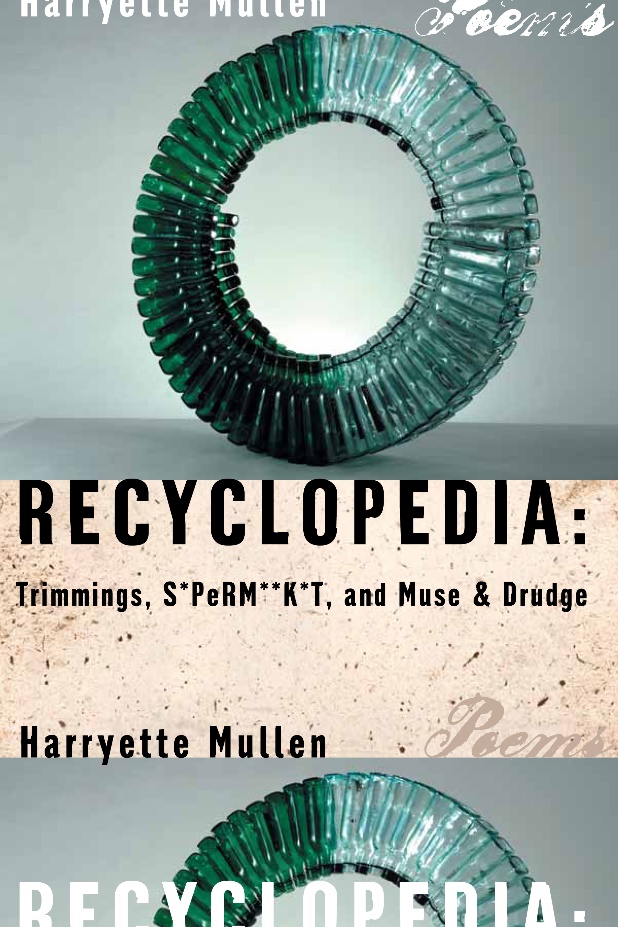
Figure 4. Front cover of Harryette
Mullen’s Recyclopedia (2006), featuring
a photograph of David Hammons’s Untitled (1989). The work is
presented as
it appeared at the Hirshhorn Museum and Sculpture Garden,
Smithsonian
Institution.[93] Reprinted with permission of
the publisher, Graywolf Press.
A few years earlier, in Sleeping with the Dictionary (2002), Mullen’s “Outside Art” imagines an artwork similar to Hammons’s sculpture:
A humble monumental
music made of syllables
or a heartbroken crystal
cathedral with gleaming walls
of Orangina bottles[.][97]
The poem presents an image of a “crystal / cathedral” with walls of Orangina soft drink bottles, which alludes to the “Crystal Cathedral” (now known as “Christ Cathedral”), a Catholic church in Orange County, California, with exterior walls and ceiling composed of glass. Mullen claims that when she wrote the poem, she was imagining using the shapely Orangina bottles to make some kind of artwork.[98] She connects her idea to “Between Walls” (1938) by William Carlos Williams, who “could see poetry in broken pieces of a green bottle in the alley behind a hospital,” and she likens this to the type of inspiration she perceives in “visionary works by untrained artists.”[99] The mixture of “high” and “low” art in these two comparisons connects to an important feature of “Outside Art,” but also of the whole volume: the bringing together of different cultural materials in a horizontal arrangement to reveal and challenge the hierarchies that differentiate their value.
“Outside Art” can be read as a metacommentary on this process. The image of the “cathedral” made of recycled Orangina bottles is both an imagined subject for an ekphrastic poem and a metaphor for the poem itself: the “humble monumental / music made of syllables.” The poem’s “music” is not composed primarily of variations in tone or vocal pitch, or the production of sound frequencies through a musical instrument, but through “syllables.” This is the medium of parts-of-words, which may create music through sound repetition and rhythm. The poem almost rhymes—“monumental” and “crystal” in the first and third lines, “syllables,” “walls,” and “bottles” in the other lines—but the off-kilter rhythm disrupts their alignment. Each line of this poem is seven syllables, and its shape on the page is almost a box, mirroring the minimalist and modern architectural design of the Crystal Cathedral. But the rhythm is irregular, and the final two lines are a bit uneven, showing disruptions to its balanced and symmetrical construction. This irregularity makes music much like a “heartbroken crystal” would, its shattered fragments reflecting sound in inconsistent intervals and directions. A structure made of Orangina bottles might do the same, the curved shapes echoing sounds in disorderly patterns. And at the same time the irregular beat of the poem is much like the syncopations and improvisations found in jazz, connecting to the creative value of such irregularities that arise from African American culture.
By referencing African American musical genres such as jazz and the blues, Mullen also connects her work with what Sam Walker describes as the “broader venerable tradition of creative recycling in Black art.”[100] As such, Mullen locates practices of reusing and repurposing within an identity-based tradition, in ways that complement and inform the interests of modernism and experimentalism. Within Sleeping with the Dictionary, Mullen, like the Language poets, uses a procedural poetics to circumvent the creative control of poet-subjectivity, but at the same time, identity comes through in the different linguistic “codes” that are juxtaposed.[101] A potent example of this occurs in Mullen’s “Dim Lady,” a parody of William Shakespeare’s Sonnet 130 (“My mistress’ eyes are nothing like the sun”).[102] Mullen’s title plays on Shakespeare’s “dark lady” figure; her version follows the same structure as Shakespeare’s sonnet, almost line-for-line, but replaces the imagery of the ideal beauty with the aesthetic of mass-cultural kitsch. The poem begins:
My honeybunch’s peepers are nothing like neon. Today’s special at Red Lobster is redder than her kisser. If Liquid Paper is white, her racks are institutional beige. If her mop were Slinkys, dishwater Slinkys would grow on her noggin.[103]
Shakespeare’s sonnet already satirises the Petrarchan blazon, critiquing an expression of desire premised on a formulaic catalogue of beauty features. But Sonnet 130 proposes its alternatives on racialized terms, asserting that instead of coral red lips, snow white skin, and fair straight hair, his mistress has breasts of “dun” (tan brown) and “black wires” for hair. Mullen’s revision picks up on the racial violences built into the lyric tradition’s language of desire, but delivers its critiques with a playful levity. Incorporating mid-century American slang, such as peepers, kisser, racks, mop, and noggin, along with brand names for mass-produced consumer items, such as Red Lobster (a seafood restaurant chain), Liquid Paper, and Slinkys, the poem speaks back to Shakespeare in the language of a “low” or popular culture. By repurposing images of cultural “trash,” such as Muzak, neon, and tablecloths in Shakey’s Pizza Parlors, the poem uses these as weapons against the cultural centre, which becomes ever harder to locate in the poem’s multilayered intertextualities.
Textual repurposing, a waste aesthetic, and politics become more explicitly linked in “Bilingual Instructions”:
Californians say No
to bilingual instruction in schools
Californians say No
to bilingual instructions on ballots
Californians say Yes
to bilingual instructions on curbside waste receptacles:
Coloque el recipiente con las flechas hacia la calle
Place container with arrow facing street
No ruede el recipiente con la tapa abierta
Do not tilt or roll container with lid open
Recortes de jardin solamente
Yard clippings only[.][104]
Mullen has stated that “the last few lines came right off the bins we have for trash collection in Los Angeles,”[105] meaning that the poem’s use of found text makes a direct social commentary by re-situating fragments from a lived exterior world. Mullen observes that “the poem is not entirely accurate because voters can ask for a Spanish-language ballot at the polling place,” before then asking, “But does everyone know to ask for it?”[106] Even so, it speaks to real social inequalities that persist, manifest in the “English-only” movement which, in 2025, achieved legislative authority with an executive order designating English as the official language of the United States. Within “Bilingual Instructions,” the “voices” are not exactly oral, but seem to be the depersonalised voices of bureaucratic signage and political campaign materials. The poem’s sets of pairings—its couplet structure, its division into top and bottom halves—create ironic juxtapositions that showcase hierarchies of power and value. The Spanish speakers, to whom the instructions on waste receptacles are primarily addressed, are presumably excluded from the category of “Californians”—the democratic constituents of the opening viewpoint. On the underside, migrant groups are marginalised along with the physical waste that is presented as their locus of agency and, by extension, are relegated to the realm of social abjection, excluded from educational and civic life. Incorporating found text, Mullen’s use of poetic form exhibits these hierarchies and attempts to address them.
CAConrad also observes the practices of power involved in waste collection in two (Soma)tic poems that feature in their collection, A Beautiful Marsupial Afternoon (2012). Here, Conrad examines the aesthetic and political potential of repurposing garbage with a more explicitly ecopolitical stance. Since 2008, Conrad has been publishing works they have named (Soma)tic poetry, composed through bodily practices that fall across categories of creative exercise, ritual, and performance. Since 2012, the books of (Soma)tics have included prose pieces printed alongside the poems, and these prose pieces are amalgamations of composition exercise, journal entry, and manifesto. Featuring the prose alongside the poetry indicates that both process and textual product are part of the poem.[107] One of these (Soma)tic exercises, entitled “Arise in Your Dross,” is dedicated to Ish Klein, “who sees art in garbage.”[108] The exercise instructs the reader to “SAVE YOUR garbage for a week, every wrapper, every box, carton, save it all,” then “SMELL IT,” while thinking deeply about where all the parts that made it came from and taking notes for a poem.[109] The next exercise, “Oil This War!,” is dedicated to Jonathan Skinner and instructs the reader to litter in wealthy neighbourhoods in “JOYFUL PROTEST” of war, inequality, and environmental destruction.[110] The exercise seems to build on the previous one, instructing the reader to “save your ‘garbage’ for a week, packaging and containers, especially plastics,” to take notes about each item, including calculations about the resources required for its production, and then to write puzzling protest messages on the garbage and toss it in wealthy neighbourhoods.[111] The prose piece for this exercise makes its political position explicit, delivering statements about wealth inequality, the role of oil in motivating and facilitating war, and its ubiquity in consumer products. The piece begins by explaining that in Philadelphia, taxes pay for workers to clean prosperous neighbourhoods “while completely ignoring working class and poor communities.”[112] Later on, it proclaims, “A tidy sidewalk does NOT EQUAL thoughtful, mindful citizenry!”[113] Instead, Conrad explains, a tidy sidewalk indicates the resources to pay workers to remove the garbage and also the presence of another location in which to deposit it as landfill—out of sight but not out of the earth. The purpose of the exercise is to reveal the violences that make “cleanliness” possible for some. And the focus here is plastic—a transformed product of oil.
The resulting poems of Conrad’s (Soma)tic practice often fit somewhere in the category of concrete poetry—sculpted on the page into unique organic and geometric forms. Their content reads like a collage of fragments produced by free-writing. Their meaning is activated not through close reading their detail, but through considering their relational contexts of composition and reception. Conrad’s poetic practice is quite antithetical to what Perloff calls “perhaps the cardinal principle” of American Language poetics: “the dismissal of ‘voice’ as the foundational principle of lyric poetry.”[114] However, the (Soma)tic exercises were partly inspired by “the writing experiments Bernadette Mayer designed for workshops she led at the Poetry Project in the 1970s,” procedural exercises that are printed in the 1986 Language anthology, along with an excerpt from Mayer’s work.[115] In an interview published in A Beautiful Marsupial Afternoon, Conrad distinguishes between the “avant-garde,” which “WAS and IS political,” the “merely experimental,” and the “offensive” “post-avant,” which “was invented by and for lazy scabs who want to bust the unions of art community.”[116] These views set up a nuanced relationship with aesthetic practices that sit within a modernist, avant-garde, or experimental tradition. In 2015, Conrad compiled a fierce response from the poetry community to a controversial performance by Kenneth Goldsmith, thereby showing a fundamental opposition to the formalist detachment reflected in Goldsmith’s practice of “uncreative” or “conceptual” writing.[117] Conrad, however, is not opposed to repurposing literary materials, though this may involve translating a Shakespeare sonnet through a crystal or tearing up a favourite poem into confetti, cooking it with oregano, and eating it.[118] These practices always involve taking notes to then write a poem, showcasing how the influence of other texts on poem-production is an embodied and invested process.
This is not unlike other “procedural” forms of poem-production, such as those practiced by Oulipo, the Language poets, and their successors.[119] However, Conrad uses procedure not to avoid but to assert lyric subjectivity as a powerful locus of resistance. Meanwhile, theirs is a lyric subject that is aggressively embodied and collectively composed. This position is asserted in their “The Right to Manifest Manifesto,” which appears at the start of A Beautiful Marsupial Afternoon:
I cannot stress enough how much this mechanistic world, as it becomes more and more efficient, resulting in ever increasing brutality, has required me to FIND MY BODY to FIND MY PLANET in order to find my poetry. If I am an extension of this world then I am an extension of garbage, shit, pesticides, bombed and smouldering cities, microchips, cyber, astral and biological pollution, BUT ALSO the beauty of a patch of unspoiled sand, all that croaks from the mud, talons on the cliff that take rock and silt so seriously flying over the spectacle for a closer inspection are nothing short of necessary.[120]
The poet identifies with waste—garbage, shit, pesticides—but also the beautiful and necessary details of the diverse living world. Waste, here, is bound up with it all, and this manifesto stresses the importance of accepting the threats that come with this creative permission. Further along, the manifesto declares that the world’s wildness is being lost with the hunting and asphyxiation of the last large wild beasts, and the poet commands, “With our poems and creative core, we must RETURN THIS WORLD to its seismic levels of wildness.”[121] The argument here is that life is being laid to waste in the processes of further conquest and production, and that it is the role of poetry to salvage it. Poetry and the “creative core” are presented as a blockade against this physical and mental conquest that would seek to “subdue our spirits” so that we “lose ourselves in the hypnotic beep of machines.”[122]
Perhaps the commitment to the manifesto is Conrad’s strongest connection to Italian Futurism, but here Marinetti’s genre—the art manifesto—is turned directly against the purpose for which it was first designed. To “lose ourselves” or lose our separation from technology and machinery was exactly what Marinetti called for a poetry to do. Here, Conrad suggests that this absorption has already taken place, or presents an imminent threat. A waste poetics makes Conrad’s statement possible. Like Marinetti’s vision of gulping slime from a “fair factory drain,” Conrad envisages themself as “an extension of garbage”; within the (Soma)tic exercises, poem-production becomes aligned with the body’s refuse as its productive output, but this does not mean poetry is devalued. Conrad maintains that poetry is a “creative core” of resistance, and they prioritise the fertile processes of regeneration and transformation that arise out of digestion.
The manifesto informs Conrad’s work beyond their deployment of the textual genre, but also in the combination of textuality with theatricality that defines the (Soma)tic exercises. Many of these exercises are designed for public disruption, such as tonguing a flower in front of security cameras, yelling, “I’M A POLLINATOR.”[123] The (Soma)tic, then, is “situational,” in the way Perloff observes of the collage and manifesto, the primary genres of the avant-guerre or “Futurist moment.”[124] The situational aesthetic relies for meaning on the relationship between the work of art and its exteriority. Whether or not it achieves its ends, it captures a revolutionary will. Initially, Conrad’s strategy looks very different to the kind of resistance offered by Mullen in the works of Recyclopedia and Sleeping with the Dictionary, in which the voices are largely ventriloquised and fragmented. These voices identify the multiple linguistic “codes” of the communities Mullen encounters; they are connected to identities, including those of the poet, but do not serve to represent a singular poet-subjectivity. Mullen’s varying registers lend themselves to a collagistic aesthetic more so than Conrad’s poems. However, through the (Soma)tic exercises, Conrad performs rituals that draw attention to the other voices and inputs that “speak” through the poet. There is a resemblance to Romantic “inspiration” here, though the inputs are registered as fundamentally material and traceable. Both Mullen and Conrad are aligned in their differing emphases on materiality in the production of poetry. For both poets, trash poetics is a means through which to engage with multiple exteriorities and to reposition items at and from the exterior in order to challenge hierarchies of cultural value.
Conclusion
In the works of the three contemporary poets I have discussed in this paper—Evelyn Reilly, Harryette Mullen, and CAConrad—language is recognised as a material entity that is analogous to or continuous with other kinds of cultural and physical material. For these poets, this recognition lends language power as a political tool, where the manipulation of linguistic materials can be seen as an act of participatory transformation. These uses of linguistic materials are made in service of political positions that are explicitly against violence—including war, racial violence, misogyny, queer- and trans-phobias, economic inequality, and environmental harm—instead seeking empowerment and justice. At the same time, many of the strategies facilitated by the attention to linguistic materiality—including asyntactical and asemantic writing, variations in punctuation and typography, the use of found text, procedural composition, challenges to the representation of a coherent lyric subject, challenges to representation itself—have their origins in an avant-garde tradition with very different, often antithetical interests. Italian Futurist manifestos are technophilic, war-hungry, and misogynistic, and even in the pre-war moment they show the germs of a developing Fascism. Inspired by Marinetti, English Vorticism took on many similar elements. What the early twentieth-century avant-garde and early twenty-first-century ecopoetics have in common is a commitment to the belief that words used in new ways have the power to change the world. This belief has been expressed explicitly in manifestos and has informed poetic formal choices. In addition, both Futurism and ecopoetics employ a toxic aesthetic—of waste, or trash—as a transformational strategy.
Trash reveals the hierarchy of value which separates treasure from refuse—both literally and figuratively—but also draws attention to the social and environmental consequences of those processes of valuation. By incorporating trash in poetry—either through depicting it as referent, incorporating pieces of it into the work through collage or performance, or re-enacting this process metaphorically (such as through intertextuality as “recycling”)—Reilly, Mullen, and Conrad make efforts to challenge and alter hierarchies of value. This remains an avant-garde creative strategy that exists in the lineage of Marinetti, who contributed to separating poetry from psychology and highlighted language’s participation in the same realm as material things. Marinetti not only incorporated a waste thematic into his writing but facilitated the conceptual move by which the aesthetic treatment of waste in poetry could be seen to interact with the treatment of waste in the extratextual world. Marinetti sought to extend metaphoric and analogical relations into literal action. The art manifesto was the genre through which he articulated this extension.
My readings here have demonstrated how flexible modernist forms can be, expressing highly antithetical political positions. This flexibility has contributed to the longevity of modernist techniques over more than a century, both for use by poets and as a set of interests for literary scholars. Throughout this period, the art manifesto has remained a significant companion document for articulating the force of modernist form, but it is also joined by the scholarly essay, which has been institutionalised, authorised, and modified with the development of the literary studies discipline within the same period. In many areas of literary studies, the genres of manifesto and scholarly essay merge at times, including in the subfield of ecocriticism and associated discourses.[125] Those more manifesto-like ecocritical essays advancing modernist and experimental writing show either a continuing faith in Marinetti’s claims for the world-changing powers of asyntactical writing or an investment in the ongoing life of the modernist avant‑garde.